
What to Expect in Your First Neurographica Session
Written By J.J.Madsen
If you’ve signed up for your first Neurographica session, you might be wondering what exactly you’re stepping into. Is it art? Is it therapy? The answer is a bit of both—and something uniquely its own. Neurographica is a creative method that combines drawing with psychological principles to help process emotions, reduce stress, and explore personal growth.
At the start of your session, you’ll likely be guided by a facilitator who explains the basic idea: your lines, shapes, and patterns represent your thoughts and feelings. The goal isn’t to create something visually “perfect,” but to allow your subconscious to express itself through simple drawing techniques.
You’ll usually begin with a prompt. This could be a question, a feeling, or a situation you want to work through—like stress about school, uncertainty about the future, or even just a general desire for clarity. Once you have your focus, you’ll start drawing what’s called a “neuro line.” These are free-flowing, unpredictable lines that move across the page without a strict plan. The randomness is intentional; it helps bypass overthinking and taps into deeper thought patterns.
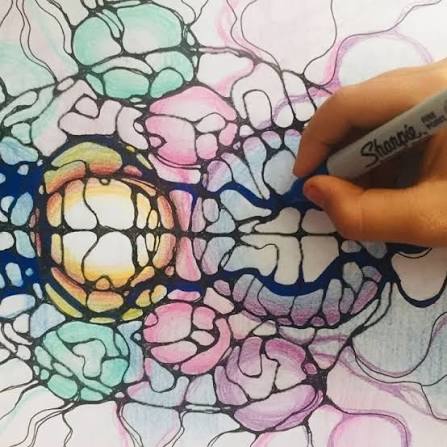
As your lines intersect, you’ll notice sharp corners forming. A key part of Neurographica is softening those intersections by rounding them out. This process may seem simple, but it’s symbolic: you’re visually transforming tension and conflict into smoother, more harmonious forms. Many people find this step surprisingly calming and even meditative.
As the session continues, you might add shapes like circles or organic forms. These elements often represent goals, resources, or areas of growth. You’ll also start to build connections between different parts of your drawing, reinforcing a sense of unity and resolution. Coloring may come later, allowing you to highlight emotions or bring balance to the piece.
Emotionally, experiences can vary. Some people feel relaxed almost immediately, while others might notice unexpected thoughts or feelings surfacing. That’s completely normal. Neurographica works by engaging both the creative and analytical parts of your brain, so it can sometimes bring hidden ideas into awareness. The important thing is to stay open and avoid judging what comes up.
By the end of your session, you’ll have a finished drawing—but more importantly, you’ll have gone through a process. Many participants report feeling lighter, clearer, or more focused afterward. Even if you don’t have a major breakthrough, the act of slowing down and creating something intentional can be deeply refreshing.
You don’t need any prior art experience to benefit from Neurographica. All you need is a willingness to try something new and let go of the idea that your drawing has to look a certain way. Over time, with more sessions, you may start to notice patterns in your work and deeper shifts in how you think and feel.
Your first Neurographica session is less about the final image and more about the journey. It’s a chance to connect with yourself in a quiet, creative way—and that alone can make it worthwhile.